

What is the heat - transfer efficiency of an induction hot pot?
Hey there! As a supplier of induction hot pots, I've been getting a lot of questions lately about the heat - transfer efficiency of these nifty kitchen gadgets. So, I thought I'd sit down and write this blog to share some insights on this topic.
First off, let's talk about what heat - transfer efficiency actually means. In simple terms, it's how well an induction hot pot can convert electrical energy into heat energy and transfer that heat to the food or liquid inside. A high heat - transfer efficiency means that less energy is wasted, and your food gets cooked faster and more evenly.
Induction hot pots work on the principle of electromagnetic induction. When you turn on an induction hot pot, an alternating current passes through a coil beneath the cooking surface. This creates a magnetic field, which in turn generates eddy currents in the pot itself. These eddy currents cause the pot to heat up, and that heat is then transferred to the food.
One of the key factors that affects the heat - transfer efficiency of an induction hot pot is the material of the pot. For example, pots made of ferromagnetic materials like cast iron and some types of stainless steel are great for induction cooking. They have high magnetic permeability, which means they can easily generate eddy currents and heat up quickly.
Let's take a look at some of the induction hot pots we offer. We have the Thick Stainless Steel Hop Soup Pot. This pot is made of high - quality stainless steel, which is not only durable but also has good heat - transfer properties. The thick construction of the pot helps to distribute the heat evenly, so you won't have any hot spots. This means that your soup or stew will cook evenly from the bottom to the top.
Another popular option is the Golden Seafood Hot Pot. This pot is designed specifically for making delicious seafood hot pots. The material it's made of is carefully selected to ensure efficient heat transfer. You can quickly bring the broth to a boil and keep it at a steady simmer, which is perfect for cooking all kinds of seafood.
Our Stainless Steel Soup Pot is also a great choice. It's lightweight yet sturdy, and it heats up rapidly on an induction cooktop. The smooth interior surface makes it easy to clean, and the heat - transfer efficiency ensures that your soups and sauces are cooked to perfection.
Now, let's dig a bit deeper into the science behind heat transfer in induction hot pots. There are three main types of heat transfer: conduction, convection, and radiation. In an induction hot pot, conduction is the primary mode of heat transfer. Once the pot heats up due to the eddy currents, the heat is conducted from the pot to the food or liquid inside.
Convection also plays a role. As the liquid at the bottom of the pot gets heated, it becomes less dense and rises, while the cooler liquid at the top sinks. This creates a convection current that helps to distribute the heat throughout the pot. Radiation, on the other hand, is relatively minor in an induction hot pot.
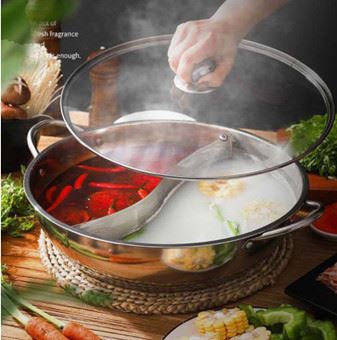

The design of the induction hot pot also impacts its heat - transfer efficiency. Pots with a flat and smooth bottom have better contact with the induction cooktop, which allows for more efficient transfer of the magnetic field and, consequently, better heat generation. Additionally, the shape of the pot can affect how the heat is distributed inside. For example, a pot with straight sides may have a different heat - distribution pattern compared to a pot with sloping sides.
When it comes to measuring the heat - transfer efficiency of an induction hot pot, there are a few ways to do it. One common method is to measure the time it takes for a certain amount of water to reach a specific temperature. A more efficient pot will heat the water faster. Another way is to measure the power consumption. A pot with higher heat - transfer efficiency will use less energy to achieve the same cooking results.
In real - world cooking scenarios, the heat - transfer efficiency of an induction hot pot can make a big difference. If you're in a hurry to make a quick meal, a pot with high efficiency will save you time. You can get your water boiling faster for pasta or your soup simmering in no time. And since it uses energy more efficiently, you'll also save on your electricity bill in the long run.
As a supplier, we're always looking for ways to improve the heat - transfer efficiency of our induction hot pots. We work with top - notch manufacturers who use the latest technologies and materials to ensure that our products perform at their best. We also conduct rigorous testing to make sure that each pot meets our high standards of quality and efficiency.
If you're in the market for an induction hot pot, I highly recommend considering our products. We have a wide range of options to suit different needs and budgets. Whether you're a professional chef or a home cook, our induction hot pots will help you create delicious meals with ease.
If you're interested in learning more about our induction hot pots or have any questions about heat - transfer efficiency, feel free to reach out. We're more than happy to have a chat and help you find the perfect pot for your kitchen. We're always open to discussing potential partnerships and bulk purchases. So, if you're a restaurant owner, a caterer, or just someone looking to stock up on great cookware, don't hesitate to contact us for a procurement discussion.
References:
- "Principles of Heat Transfer" by Frank Kreith and Mark S. Bohn
- "Induction Cooking Technology: A Review" in a cooking science journal