

How does the weight of a 6 wheels shopping cart affect its portability?
As a supplier of 6 Wheels Shopping Carts, I've spent years delving into the nuances of shopping cart design and functionality. One question that frequently arises in the industry and among our customers is: How does the weight of a 6 wheels shopping cart affect its portability? In this blog post, I'll explore this topic in depth, drawing on both scientific principles and practical experience.
The Basics of Portability and Weight
Portability, in the context of a shopping cart, refers to how easily it can be moved around. It encompasses factors such as maneuverability, ease of lifting (if required), and the effort needed to push or pull the cart. Weight is a critical factor that directly impacts all these aspects of portability.
Let's start with the fundamental relationship between weight and force. According to Newton's second law of motion, F = ma, where F is the force applied, m is the mass (which is related to weight), and a is the acceleration. When it comes to moving a shopping cart, the force you need to apply to start it moving (overcome inertia) and keep it moving (against friction) is directly proportional to its mass. A heavier cart requires more force to move, all else being equal.
Impact on Maneuverability
Maneuverability is about how easily you can change the direction of the cart. A 6 wheels shopping cart is designed to provide better stability and balance compared to carts with fewer wheels. However, the weight of the cart can significantly affect its ability to turn smoothly.
A heavier cart has more inertia, which means it resists changes in its motion. When you try to turn a heavy 6 wheels shopping cart, you need to apply more force to overcome this inertia and change the direction of the wheels. This can make it more difficult to navigate through narrow aisles or around sharp corners in a supermarket. For example, if you're pushing a fully loaded 6 wheels shopping cart that weighs a lot, you might find it challenging to make quick turns without hitting other items or people.
On the other hand, a lighter 6 wheels shopping cart is more responsive to steering inputs. It can be easily turned with less effort, allowing for better maneuverability in crowded spaces. This is especially important in busy retail environments where customers need to move quickly and efficiently through the store.
Ease of Lifting
In some situations, customers may need to lift the shopping cart, such as when they need to get it over a small obstacle or onto a platform. The weight of the cart plays a crucial role in how easy or difficult this is.
A heavy 6 wheels shopping cart can be a real challenge to lift. It requires significant strength and effort, which may be beyond the capabilities of some customers, especially the elderly or those with physical limitations. This can lead to a negative shopping experience and even pose a safety risk if the cart is dropped or mishandled during the lifting process.
In contrast, a lighter 6 wheels shopping cart is much easier to lift. It reduces the physical strain on the user and makes it more convenient to handle in various situations. For example, if a customer needs to lift the cart onto a curb or into the trunk of a car, a lighter cart can be lifted with less effort and greater ease.
Pushing and Pulling Effort
The effort required to push or pull a shopping cart is directly related to its weight. A heavier cart has more friction with the ground, which means more force is needed to overcome this friction and keep the cart moving.

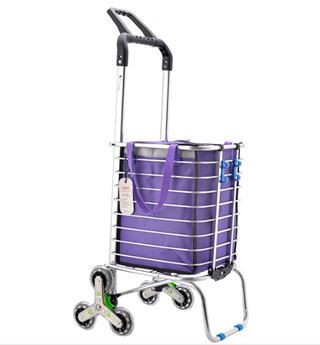
When you push a heavy 6 wheels shopping cart, you need to apply more force to maintain a constant speed. This can be tiring, especially if you're pushing the cart for a long distance. In a large supermarket, customers may need to push their carts throughout the store, and a heavy cart can make this task much more cumbersome.
A lighter 6 wheels shopping cart, on the other hand, requires less force to push or pull. It glides more easily over the floor, reducing the physical effort required from the user. This can make the shopping experience more enjoyable and less exhausting, which is beneficial for both the customer and the retailer.
Balancing Weight and Other Factors
While a lighter 6 wheels shopping cart generally offers better portability, it's important to consider other factors as well. For example, the construction materials of the cart can affect its durability and strength. A very light cart may be made of flimsy materials that are prone to breaking or damage, especially if it's used frequently or loaded with heavy items.
We need to find a balance between weight and other important characteristics. At our company, we use high - quality materials that are both lightweight and strong. This allows us to produce 6 Wheels Shopping Carts that are portable without sacrificing durability. For instance, we may use lightweight yet sturdy plastics or aluminum alloys in the construction of the cart frame, which helps to reduce the overall weight while maintaining the necessary strength.
Comparing with Other Types of Shopping Carts
It's also interesting to compare the portability of 6 wheels shopping carts with other types, such as 3 Wheel Steel Shopping Cart and Aluminium Handle Shopping Cart with.
A 3 - wheel steel shopping cart typically has a different weight distribution and fewer wheels, which can affect its stability and maneuverability. Steel is a relatively heavy material, so these carts tend to be heavier than 6 wheels shopping carts made from lighter materials. This can make them more difficult to move around, especially when it comes to turning and lifting.
Aluminium handle shopping carts often have a more ergonomic design, but their portability also depends on the overall weight of the cart. If the cart body is heavy, even with an aluminium handle, it may still be challenging to move. In comparison, our well - designed 6 wheels shopping carts offer a good balance of portability, stability, and functionality.
Conclusion
In conclusion, the weight of a 6 wheels shopping cart has a significant impact on its portability. A lighter cart is generally more maneuverable, easier to lift, and requires less effort to push or pull. However, it's essential to balance weight with other factors such as durability and strength.
As a supplier of 6 Wheels Shopping Cart, we understand the importance of providing high - quality shopping carts that meet the needs of both retailers and customers. Our 6 wheels shopping carts are designed to be lightweight yet durable, offering excellent portability without compromising on performance.
If you're interested in purchasing our 6 wheels shopping carts or have any questions about our products, we encourage you to contact us for a procurement discussion. We're committed to providing the best solutions for your shopping cart needs.
References
- Newton, Isaac. Philosophiæ Naturalis Principia Mathematica. 1687.
- Engineering textbooks on mechanics and materials science for understanding the relationship between weight, force, and materials in shopping cart design.